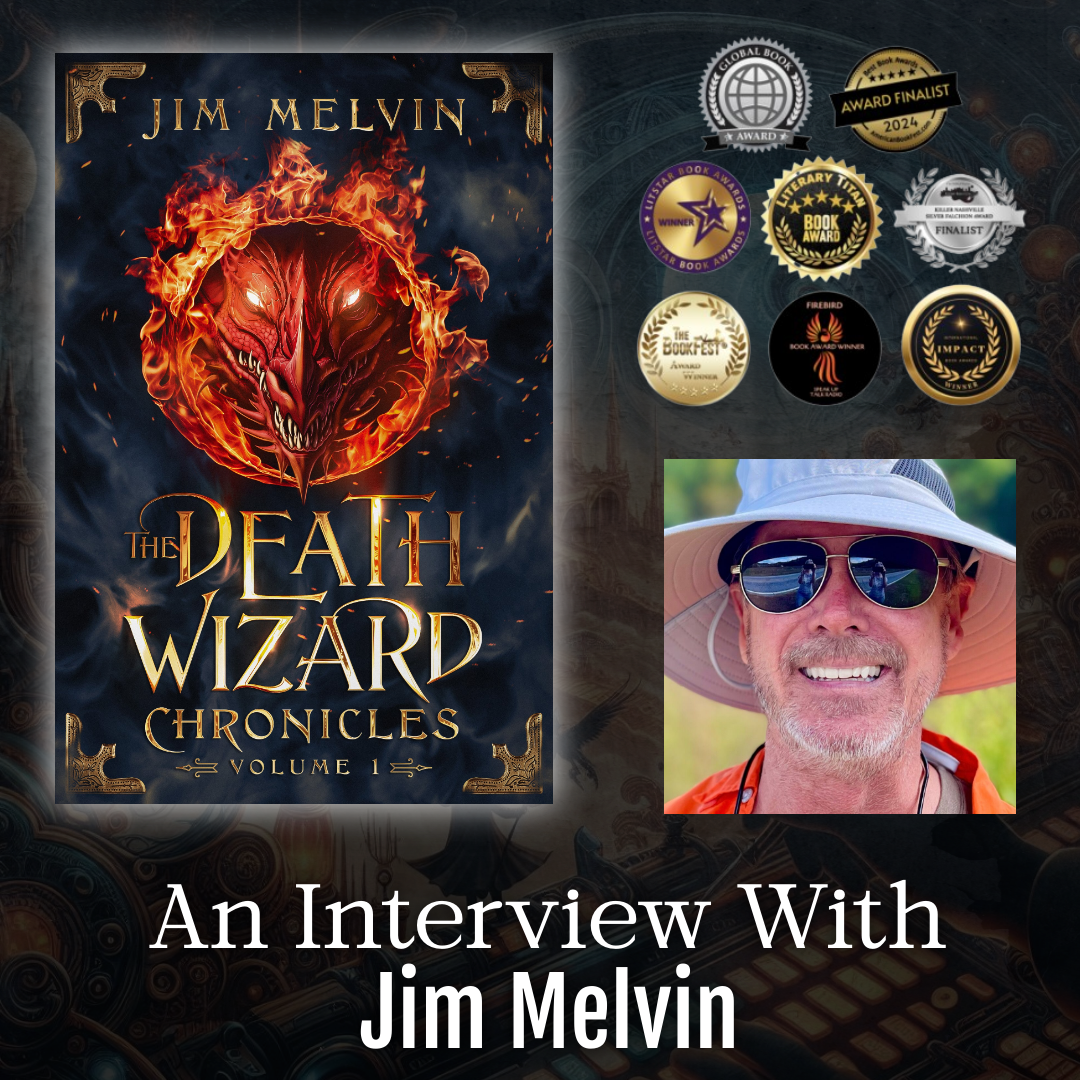

Step into the imaginative world of Jim Melvin, the multi-award-winning author behind The Dark Circles Trilogy. Discover the inspirations behind his epic tales and get an exclusive peek at what’s coming next.

Title Of Book: The Death Wizard Chronicles
Series: Volume 1
By: Jim Melvin
Genre: Fantasy
Sub-Genre: Action/Adventure, Coming of Age, Dark Fantasy, Epic Fantasy
Release Date: April 28th 2025
About The Book:
ACCLAIMED DARK FANTASY SERIES RETURNS TO LIFE!
From award-winning fantasy author Jim Melvin comes a new three-volume edition of his dark fantasy series, The Death Wizard Chronicles. Volumes 2 and 3 will debut later in 2025. Dive into a fantastical realm where magic, monsters, and mayhem collide, crafting an unforgettable adventure. With a unique blend of fierce battles, shadowy magic, and a richly woven narrative, this series explores profound themes of transformation and sacrifice. This isn’t just a tale about dragons, wizards, and warriors. It’s about the choices that shape our destinies. Join the journey and uncover the secrets of Triken!
~~Only a Death Wizard can die. And live again.~~
For a thousand years, none rivaled the power of Torg, the Death Wizard who ruled his people and maintained peace on Triken. But a new menace has suddenly arisen. The evil sorcerer Invictus poses a threat greater than Torg has ever faced, his insatiable hunger for power casting a dark shadow over the forces of good. When Invictus imprisons the Death Wizard in a horrendous pit bored into the solid rock of a frozen mountain, Triken’s fate hangs precariously in the balance. Torg becomes freedom’s last hope. But to harness the full extent of his powers, he first must die and be reborn.
Action-packed and yet profound, this dark fantasy saga will thrill and challenge fans of the genre in new and thought-provoking ways.

Prologue
Such darkness he had never known. In all the centuries of his long life, the wizard had felt nothing as loathsome as this. Torturous days and weeks lay behind, endless horror ahead. He was helpless in the grip of doom.
For a millennium he had freely roamed the planet Triken, using his prodigious powers to unite the forces of good. But now a sorcerer held him captive in a pit bored into the solid rock of a frozen mountain. Beyond the walls of his prison, a war would soon take place that would dwarf all others. An evil had arisen that threatened not just Triken but the fabric that held together the universe. Only the wizard could stop it. But first he had to survive.
The pit was 200 cubits deep but only three cubits in diameter. The prisoner lay curled at its bottom like a snake in a well. Fetid dankness swirled about him, creeping in and out of his nostrils with every breath. A chill like no other clung to his body, freezing his heart.
All he had left were his memories, which provided his only relief from the relentless blackness. He immersed himself in them, focusing on the past instead of the present. Doing this went against all that he held true. But it kept him sane.
For a fraction of a moment. And another. Another …
Interview With Jim Melvin
What books or authors have most influenced your own writing?
Like most writers, I’ve been influenced by a variety of books and authors. I go into more detail about Stephen King in the next question, but he certainly has played a significant role in my writing. In fact, without King, I might not have even become a novelist. When I first read The Lord of the Rings back in the 1970s, J.R.R. Tolkien blew my mind. I have since re-read LOTR more than twenty-five times. For me, it’s a kind of yearly celebratory event. George R.R. Martin is extraordinary. I can only dream to be that good. Others include Steven Erikson and Stephen Donaldson. I guess I enjoy books written by Steves. 😀 But like many writers, I’ve read well over a thousand books in my life, and there were very few that I didn’t find enriching in some regard. My favorite literary writer is John Updike. Rabbit, Run was pure genius.

What famous author do you wish would be your mentor?
I would choose Stephen King. Whether you love him, hate him, or fall somewhere in between, there’s no denying that King is an ingenious storyteller. And as King repeatedly points whenever he talks about his novels, the most important part of fiction writing is the ability to tell a compelling story. All other elements—though important—pale in comparison. How many of us have become so engrossed with a novel that we read half the night even though the alarm is set for 7? Readers want to find out what happens! It’s as simple (and as complicated) as that. In this regard, King is an all-time master.
Describe a typical writing day.
When I’m writing the first draft of a novel, I usually write between 8 p.m. and midnight seven days a week. I then spend about an hour the next morning editing what I wrote the previous night so that I can start right up again without using precious writing time to edit. I’m the type who tends to write a relatively sloppy first draft. My more intense editing comes during the revision process. Depending on the length of the book, it typically takes me about three months to write the first draft and three more months to revise it into a polished product.
Is there lots to do before you dive in and start writing the story?
Funny you should ask. I wrote the first words of the original Death Wizard Chronicles way back in 2004. And though the Google search engine already existed, it wasn’t the platform where most writers turned to research their novels. Instead, writers either went to their local library, bought paperback or hardcover books in bookstores, or ordered them online. I chose the online route mainly because I wanted to own the books so that I could scribble in them. I found some amazing online deals on used books, some costing only a dollar or two. I didn’t care what condition they were in. I only cared that they were in decent enough shape to be readable. Very quickly, I ordered seventy-five books, most of which are still stored in dusty boxes in my basement a quarter of a century later. I bought everything from The Art of War to Medieval Architecture to Horses for Dummies. In six weeks, I read almost every page of all seventy-five books—averaging at least two books per day—and took extensive notes that I organized into categories such as architecture, clothing, food, weapons, armor, fighting tips, battle tactics, etc.
And I didn’t stop there. I took an hours-long hike in the Appalachian Mountains with a well-known naturalist, peppering him with questions about everything from black bears to wildflowers. I did a slew of phone interviews that included a highly trained martial artist, another guy who was an expert on medieval weapons, and a woman who was one of the few people in the world able to translate English to Pali, an ancient Indian language that I chose to serve as my series’ “ancient tongue.”
Partially because of Horses for Dummies but more so because the crucial strands of knowledge I had previously lacked were now in place, I felt like a horse itching to leap over the pasture fence and take a raucous run in the forest that lay beyond.
What inspired you to start writing?
During my teen years in the mid-1970s, I was one of those relatively rare students who was equally adept at math and English. The summer before my junior year in high school, I decided it was time to choose between the two disciplines. I have friends who focused on math and ended up with lucrative careers. But in the Seventies, I was an enthusiastic fan of a new author named Stephen King and a much older one named J.R.R. Tolkien. Their combined influences gave birth to an irresistible desire to become a bestselling novelist. In the years that followed, I bragged to family and friends about becoming an international sensation and making at least $75 million in book sales. (I’m not there yet, in either regard.)
What do you hope your readers take away from this book?
One of my talking points for The Death Wizard Chronicles is that the series is “action-packed and yet profound.” The “action-packed” part is self-explanatory. But the “profound” part is more nebulous. I might be wrong (I hope I’m wrong), but I believe some readers tend to view genres like dark fantasy as being “kid stuff” or lightweight. But nothing could be further from the truth. A book’s genre doesn’t define whether it has literary depth. That is determined by the author’s ability to incorporate literary techniques into the narrative (which is what a critic means when he or she says there is a lot going on between the lines). The odds are good that if a book leaves a lasting impression on a reader, it’s because the author has skillfully incorporated theme, symbolism, foreshadowing, allegory, irony, flashback, paradox, parallel structuring, etc. Most readers don’t recognize this on a conscious level, but literary techniques can have a powerful effect on the subconscious that can stay with you for days, months, years, or even a lifetime. This is what I mean when I say profound.
What is the future for the characters? Will there be a sequel?
The new edition of The Death Wizard Chronicles will be a three-volume series, with each volume containing two books (I stole this from Tolkien.) I’ve chosen to do it this way for a lot of reasons, but one of the main ones is that I’ll only have to pay for three covers instead of six. 🤣
What is the key theme and/or message in the book?
The Death Wizard Chronicles explores the fear of death as a human condition. The key theme is that it’s not death we should fear but rather a life steeped in ignorance. The series goes into detail (between the lines) about how ignorance is defined on a deeper level.
What is the significance of the title?
My main character is a wizard with the ability to meditate so deeply that he literally stops his heart and dies. He then enters the Realm of Death and feeds on death energy. When he returns to life a short time after, he is engorged with magical powers. Therefore, he is called a Death Wizard.
If you had to describe yourself in three words, what would they be?
Generous, considerate, fair.
Connect with Jim
Website: https://jim-melvin.com
Blog: https://jimmelvin.substack.com
Facebook: https://www.facebook.com/dark.circles.series
Twitter: https://twitter.com/deathwizard57
Amazon Author Page: https://www.amazon.com/stores/Jim-Melvin/author/B005DMT2KY
BookBub: https://www.bookbub.com/search/authors?search=Jim%20Melvin
Goodreads: https://www.goodreads.com/author/list/945032.Jim_Melvin


